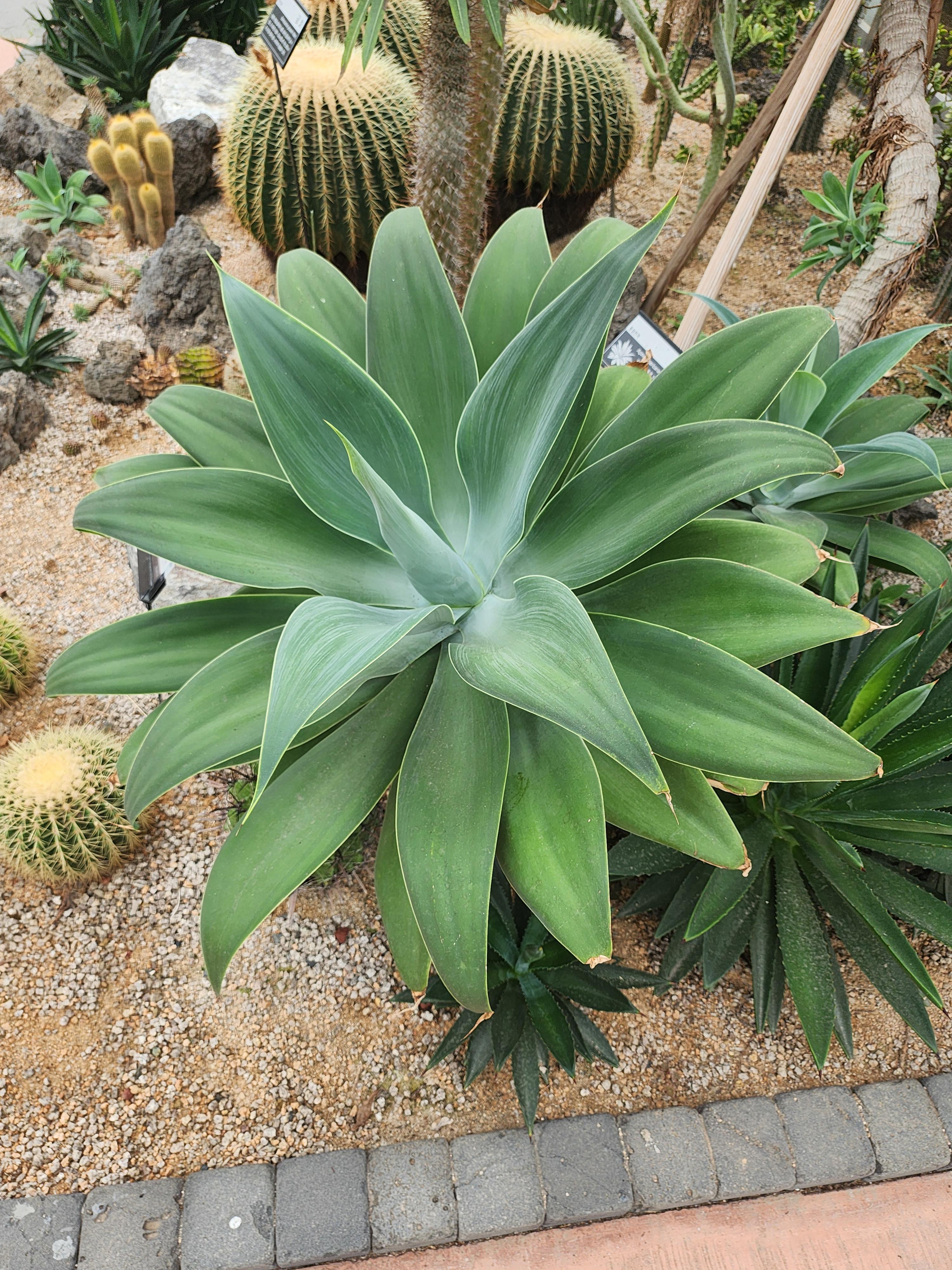
학명 : Agave sp.
* 확실한 종명은 알지 못하겠으나 Agave attenuata Salm Dyck (여우꼬리용설란)으로 보인다
분류 : 비짜루과(Asparagaceae)
사진 : 2025.09.19 안산식물원


위키페디아 설명
Agave (/əˈɡɑːvi/; also UK: /əˈɡeɪvi/;[3] Anglo-Hispanic, also US: /əˈɡɑːveɪ/)[4] is a genus of monocots native to the arid regions of the Americas. The genus is primarily known for its succulent and xerophytic species that typically form large rosettes of strong, fleshy leaves.[5]
Many plants in this genus may be considered perennial, because they require several to many years to mature and flower.[5][page needed][6] However, most Agave species are more accurately described as monocarpic (일생에 단 한 번 꽃 피우는) rosettes or multiannuals, since each individual rosette flowers only once and then dies; a small number of Agave species are polycarpic.[5][page needed][6]
Along with plants from the closely related genera Yucca, Hesperoyucca, and Hesperaloe, various Agave species are popular ornamental plants in hot, dry climates, as they require very little supplemental water to survive.[6] Most Agave species grow very slowly.[5] Some Agave species are known by the common name "century plant".[7]
....................... 중략 ..........................
The succulent leaves of most Agave species have sharp marginal teeth, an extremely sharp terminal spine, and are very fibrous inside.[6] The stout stem is usually extremely short, which may make the plant appear as though it is stemless.
Agave rosettes are mostly monocarpic, though some species are polycarpic.[5]: 30 During flowering, a tall stem or "mast" ("quiote" in Mexico), which can grow to be 12 metres (40 feet) high,[8] and Agave salmiana can be significantly taller.[citation needed] The panicle grows apically from the center of the rosette and bears a large number of short, tubular flowers and sometimes vegetatively produced bulbils (a form of asexual reproduction). After pollination/fertilization and subsequent fruit development, in monocarpic species, the original rosette dies. However, throughout the lifetime of many Agave species, rhizomatous suckers develop above the roots at the base of the rosette.[5]: 30 These suckers go on to form new plants after the original rosette desiccates and dies.[5][page needed] Not all agaves produce suckers throughout their lifetimes; some species rarely or never produce suckers, while others may only develop suckers after final maturation with inflorescence.[5][page needed] Some varieties can live for 60 years before flowering.[8]
,,,,,,,,,,,,,,,,,,,,,,,,,,,,,,,,,,,,,, 하략 ...........................................
Agave attenuata Salm Dyck (여우꼬리용설란) 참조 사이트
https://worldofsucculents.com/agave-attenuata/
'선인장과 다육식물' 카테고리의 다른 글
| 빅토리아용설란(세설) (0) | 2025.12.08 |
|---|---|
| 무륜주선인장 (0) | 2025.12.08 |
| 추수감사절선인장(게발선인장) (0) | 2024.03.20 |
| Monstera adansonii (0) | 2024.01.12 |
| 괴마옥(怪馬玉) (0) | 2024.01.12 |