메밀여뀌(2)
https://daehyo49.tistory.com/7817430
메밀여뀌(1)
https://daehyo49.tistory.com/7807947
덩굴모밀(1) (덩굴여뀌와 메밀여뀌의 구분)
https://daehyo49.tistory.com/7811714
학명: Persicaria capitata (Buch.-Ham. ex D.Don) H.Gross
학명 이명: Polygonum capitatum Buch.-Ham. ex D. Don
분류: 마디풀과(Polygonaceae)
학명 풀이
Persicaria : Medieval name referring to the likeness of the leaves to a peach tree (복사나무 잎을 닮은 여뀌 종류 가리킨 것)
capitatum : 두상의
중국어명: 头花蓼
일어명: ヒメツルソバ(姫蔓蕎메밀 교 麦보리 맥)
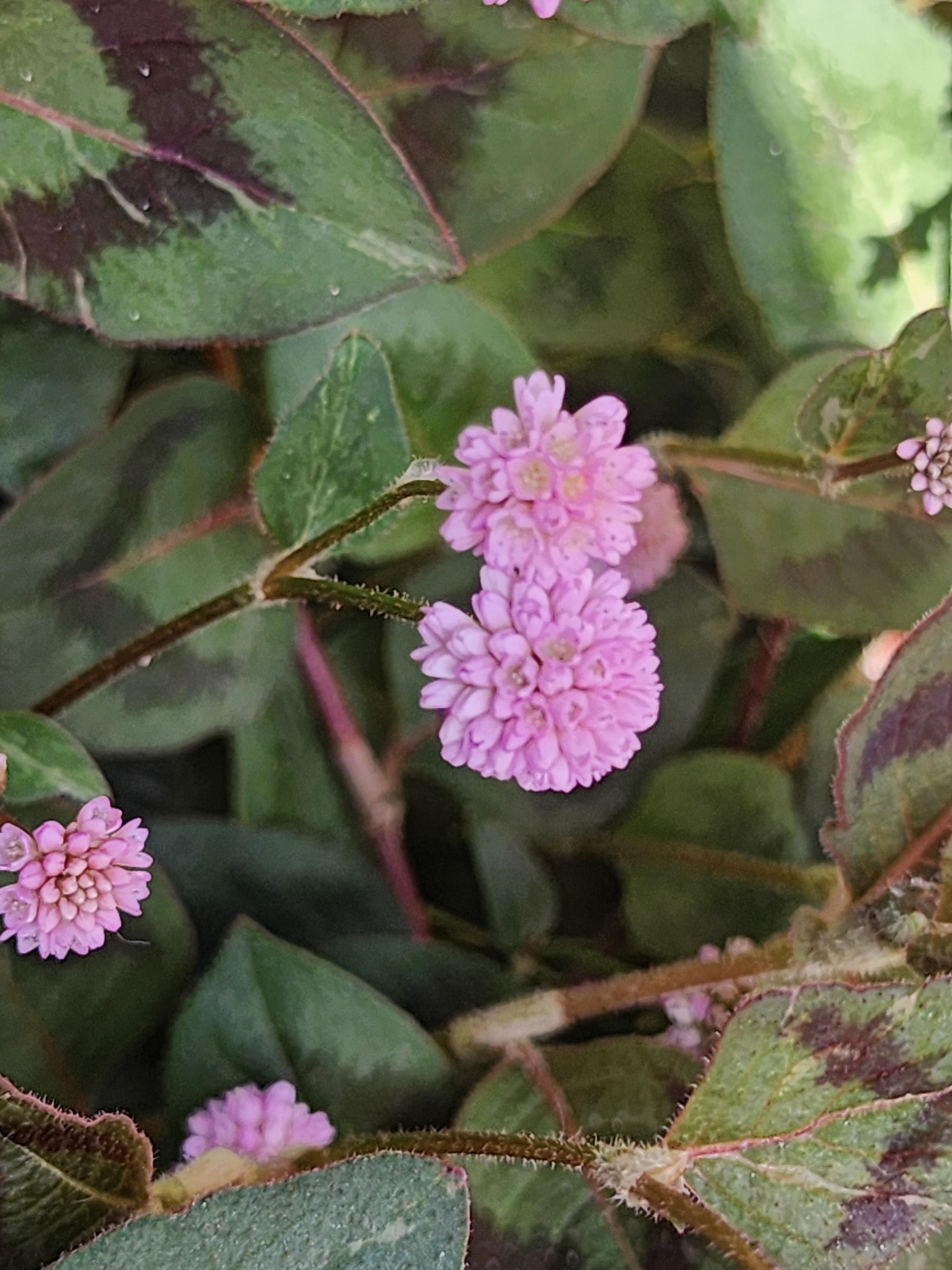
사진 : 2026.03.28 창경궁



FOC 설명
Polygonum capitatum Buchanan-Hamilton ex D. Don, Prodr. Fl. Nepal. 73. 1825.
头花蓼 tou hua liao
(학명 이명)
Cephalophilon capitatum (Buchanan-Hamilton ex D. Don) Tzvelev; Persicaria capitata (Buchanan-Hamilton ex D. Don) H. Gross.
(설명)
Herbs perennial. Stems creeping, tufted, ligneous at base, sparsely glandular hairy or nearly glabrous, much branched, rooting from nodes, internodes shorter than leaf blades; branchlet suberect, angulate, sparsely glandular hairy. Petiole 2-3 mm, sometimes auriculate at base; leaf blade sometimes with a large blackish spot adaxially, ovate or elliptic, 1.5-3 × 1-2.5 cm, both surfaces glandular hairy, base cuneate, margin entire and glandular hairy, apex acute; ocrea tubular, 5-8 mm, membranous, sparsely glandular hairy, apex truncate, ciliate. Inflorescence terminal, capitate, solitary or geminate(쌍생), 6-10 mm in diam.; peduncle glandular hairy; bracts narrowly ovate, membranous. Pedicel very short. Perianth pinkish, 5-parted; tepals elliptic, 2-3 mm. Stamens 8, included. Styles 3, connate to below middle, equaling perianth; stigmas capitate. Achenes included in persistent perianth, black-brown, slightly shiny, narrowly ovoid, trigonous, 1.5-2 mm, densely punctate. Fl. Jun-Sep, fr. Aug-Oct.
Mountain slopes, shaded places in valleys; 600-3500 m. Guangdong, Guangxi, Guizhou, Hubei, Hunan, Jiangxi, Sichuan, Taiwan, Xizang, Yunnan [Bhutan, N India, Malaysia, Myanmar, Nepal, Sikkim, Sri Lanka, Thailand, Vietnam].
This species is used medicinally, and is cultivated as an ornamental in other parts of the world (e.g., in Australia).
Newly naturalized in Taiwan (see Hsu, T. W., S. M. Ku & C. I. Peng. Taiwania 49(3): 183. 2004).