학명 : Symphoricarpos albus (L.) S.F.Blake
분류 : 인동과(Caprifoliaceae)
학명 풀이
Symphoricarpos : 그리스어 sumphoreîn "to bear together" + karpós "fruit".
albus : 흰(열매 색깔)
영명 : snowberry, waxberry and ghostberry.
국내 유통명 : 인동딸기(위키백과), 스노베리(스노우베리)
https://100.daum.net/encyclopedia/view/b13s0149a
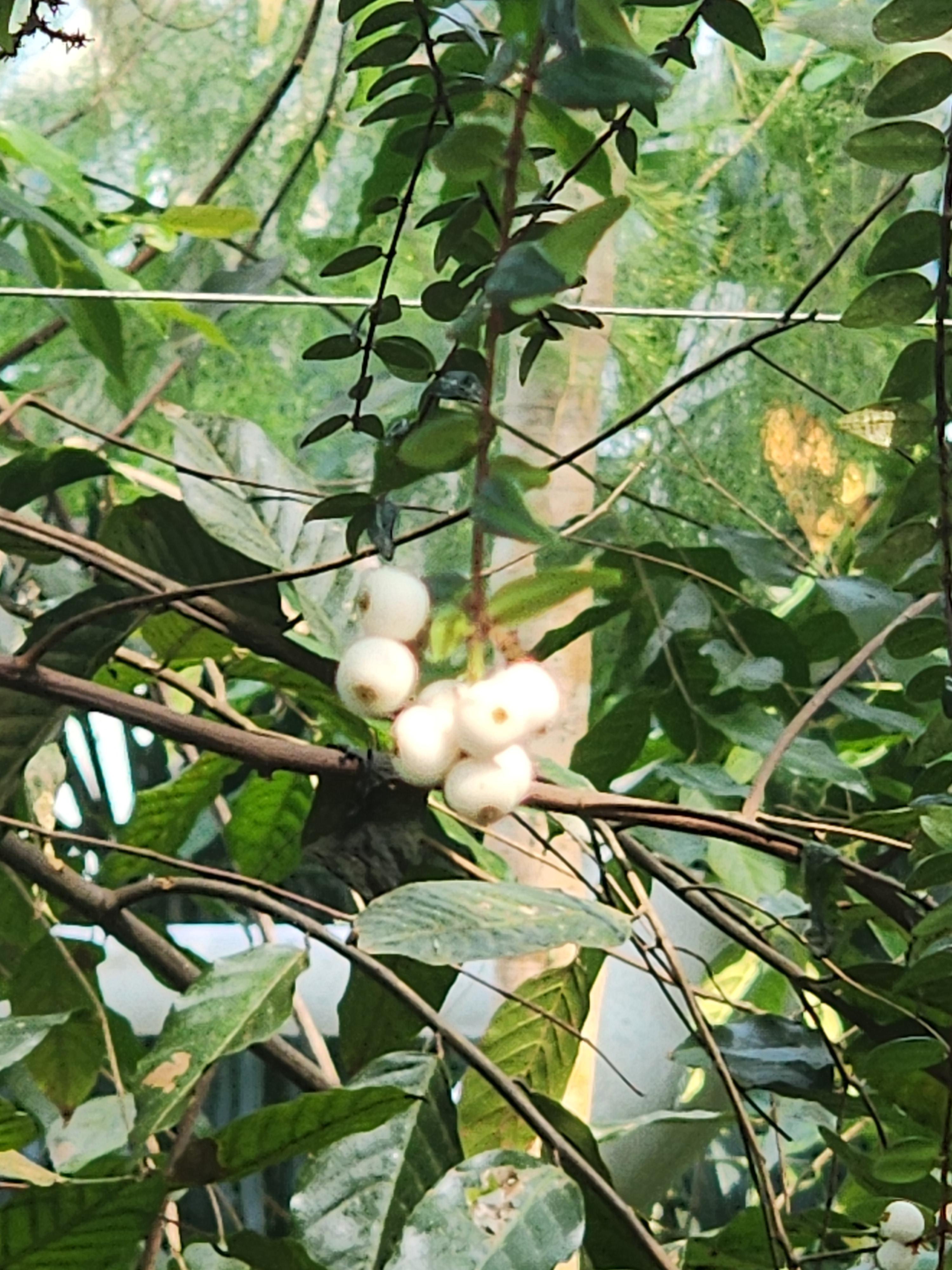
사진 : 2026.03.27 서천 국립생태원



Wikipedia 설명
속에 대한 설명
Symphoricarpos is a small genus of about 15 species of deciduous shrubs in the family Caprifoliaceae. With the exception of the Chinese coralberry, S. sinensis, which is indigenous to western China, all species are native to North and Central America. The name of the genus is derived from the Ancient Greek words συμφορεῖν (sumphoreîn), meaning "to bear together", and καρπός (karpós), meaning "fruit". It refers to the closely packed clusters of berries the species produces.[4] Species in the genus are known by several common names, including snowberry, waxberry and ghostberry.
Snowberry is a resilient(회복력이 있는 , 탄력이 있는) plant able to withstand a variety of conditions. Their deep roots allow them to survive dry seasons, and they have been known to grow in a variety of soil types such as light sandy soil, medium loamy soil and heavier clay soil.[5] Snowberry plants are most commonly found low-to mid elevations, in forests, dry or moist openings, rocky hillsides or near riverbanks and streams.[5] Snowberry plants are also able to grow in a wide range of acidic and basic pHs and sunlight conditions.[5]
Description
Symphoricarpos leaves are 1.5–5 cm (0.59–1.97 in) long, rounded, entire or with one or two lobes at the base.[6] The flowers are small, greenish-white to pink, in small clusters of 5–15 together in most species, solitary or in pairs in some (e.g. S. microphyllus). The fruit is conspicuous, 1–2 cm (0.5–1 in) in diameter, soft, varying from white (e.g. S. albus) to pink (S. microphyllus) to red (S. orbiculatus) and in one species (S. sinensis), blackish purple. When the white berries are broken open, the interior looks like fine, sparkling granular snow. The flesh is spongy and contains two 2–5 mm long, whitish stone seeds. The seeds, which contain endosperm and a small embryo, are egg-shaped and more or less flattened. They have a very tough, hard, impermeable(불투과성) covering, and so are very hard to germinate and may lie dormant for up to ten years.
The berries are not edible but have a wintergreen flavor, similar to the related wintergreen plant (Gaultheria procumbens).
The white berries create a cracking sound when they are stepped into firm ground.
Species
Species accepted as of August 2015[7]
Symphoricarpos acutus (A.Gray) Dieck – Sharpleaf snowberry: California, Nevada, Oregon
Symphoricarpos albus (L.) S.F.Blake – Common snowberry: Canada + USA
Symphoricarpos × chenaultii Rehder – Chenault coralberry
Symphoricarpos × doorenbosii Krüssm.
Symphoricarpos guadalupensis Correll – McKittrick's snowberry: western Texas
Symphoricarpos guatemalensis J.K. Williams: Guatemala
Symphoricarpos hesperius G.N.Jones – Trailing snowberry: California, Baja California, Oregon, Washington, British Columbia
Symphoricarpos longiflorus A.Gray – Desert snowberry: southwestern USA, northwestern Mexico
Symphoricarpos microphyllus Kunth – Littleleaf snowberry: Mexico, Guatemala, New Mexico
Symphoricarpos mollis Nutt. – Creeping snowberry: California
Symphoricarpos occidentalis Hook. – Western snowberry, Wolfberry: USA + Canada
Symphoricarpos orbiculatus Moench – Coralberry: northeastern Mexico, eastern + central USA
Symphoricarpos oreophilus A.Gray – Mountain snowberry: northern Mexico, western USA, western Canada
Symphoricarpos palmeri G.N.Jones – Palmer's snowberry: Mexico, southwestern USA
Symphoricarpos parishii Rydb.: California, Nevada, Baja California
Symphoricarpos rotundifolius A.Gray – Round-leaved snowberry: Mexico, southwestern USA
Symphoricarpos sinensis – Chinese snowberry: China
Symphoricarpos vaccinioides Rydb. – Roundleaf snowberry: California
Ecology
Snowberry is a hermaphroditic species meaning it contains both male and female reproductive organs.[8] It has the ability to grow via seeds but typically reproduces by releasing shoots from a rhizome. This method of shoot dispersal allows snowberry to grow in dense populations of bushes and trees.[8] Snowberry plants also tend to use a reproductive method called layering in which the plant's vertical stems will wilt and droop until they touch surrounding soil.[9] Upon making contact with soil, roots will begin to form. Snowberry plants are resilient and studies have proved they are able to tolerate dormant seasonal fires. These fires actually encourage the snowberry plant's layering reproductive method, as the regeneration of new plants results in an increased number of stems and therefore more opportunities for layering to occur.[9]
Common snowberry (S. albus) is a resilient plant that thrives in dry woodland conditions.[10] Its berries ripen during fall and last through winter, making it an important winter food source for quail(메추라기) and grouse(뇌조, 들꿩). However, the berries are considered poisonous to humans. The berries contain the isoquinoline alkaloid chelidonine, as well as other alkaloids. Ingesting the berries causes mild symptoms of vomiting, dizziness, and slight sedation(진정제) in children.
Cultivation
Common snowberry is a popular ornamental shrub in gardens, grown for its decorative white fruit and wildlife gardening. It is also a useful landscaping plant due to its extreme versatility(다재, 다능)—tolerating sun, shade, heat, cold, drought, and inundation(범람, 침수).
종(Symphoricarpos albus)에 대한 설명
Symphoricarpos albus is a species of flowering plant in the honeysuckle family known by the common name common snowberry.[3] Native to North America, it is browsed (뜯어먹다) by some animals and planted for ornamental and ecological purposes, but is poisonous to humans.
Description
S. albus is an erect, deciduous shrub that produces a stiff, branching main stem and often several smaller shoots from a rhizome. It can spread and colonise an area to form a dense thicket.[4] It reaches 1–2 metres (3+1⁄2–6+1⁄2 feet) in maximum height. The leaves are oppositely arranged on the spreading branches. They are generally oval in shape and vary in size, growing up to 5 centimetres (2 inches) long, or slightly larger on the shoots. The inflorescence is a raceme of up to 16 flowers. Each flower has a small, five-toothed calyx of sepals. The bell-shaped, rounded corolla is approximately 0.5 cm (1⁄4 in) long and is bright pink in colour. It has pointed lobes at the mouth, and the inside is filled with white hairs. The fruit is a fleshy white berry-like drupe measuring around 1 cm in diameter, containing two seeds. The plant mainly reproduces vegetatively by sprouting from its spreading rhizome, but sometimes via seed.[4] Birds disperse the seeds after they eat the fruit.[4]
There are two varieties:
S. albus var. albus, native to eastern North America
S. albus var. laevigatus, native to the Pacific coast. It is a larger shrub, up to 2 m (6+1⁄2 ft) tall, with slightly larger fruit. Some botanists treat it as a distinct species, Symphoricarpos rivularis.
Distribution and habitat
S. albus occurs across much of Canada and the northern and western United States.[5][6]
It grows in shady and moist mountain and forest habitat, in woodlands and on floodplains and riverbanks. It can grow in a wide variety of habitat types.[4] It is naturalized in parts of Britain, where it has been planted as an ornamental and cover for game animals.[7]
Ecology
This shrub is an important food source for a number of animals, including bighorn sheep, white-tailed deer, and grizzly bears(회색곰).[4] Livestock such as cattle and sheep readily browse it.[4] Many birds and small mammals use it for food and cover.[4] Pocket gophers (뒤쥐)dig burrows(굴, 은신처) underneath it during the winter.[4]
Toxicity
The fruit and shrub are poisonous to humans, causing vomiting.[8]
'원예.재배식물 > O-Z' 카테고리의 다른 글
| Ochna kirkii(미키마우스나무) (0) | 2026.05.11 |
|---|---|
| Seashore Mangosteen (0) | 2026.05.10 |
| Sanchezia speciosa(금엽목) (3) (0) | 2026.02.26 |
| Streptocarpus saxorum (4) (0) | 2026.02.25 |
| Sphaeropteris cooperi(나무고사리 종류) (0) | 2026.02.13 |